 Early Times Report Early Times Report
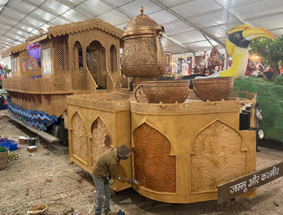
NEW DELHI, Jan 24: Final touches are being given to the Jammu & Kashmir tableau that will grace the Republic Day Parade at Kartavya Path, New Delhi, on 26 January 2026. Conceived as a vibrant cultural statement, the tableau celebrates the timeless artistic heritage and living performance traditions of the Union Territory, presenting Jammu & Kashmir as a land where craftsmanship and creativity flow seamlessly across generations.
Prepared under the able guidance of the Chief Secretary, Shri Atal Dulloo, and the Principal Secretary, Culture, Shri Brij Mohan, the tableau is being executed by Smt. Harvinder Kaur, Secretary, J&K Academy of Art, Culture and Languages. The concept and artistic direction have been developed by eminent theatre personality and cultural visionary Shri Balwant Thakur, while the fabrication is being meticulously carried out by Natrang, Jammu.
The Jammu & Kashmir tableau unfolds like a silken tapestry, offering a panoramic view of the region's cultural continuum. On the left flank, the tableau pays homage to ancestral arts that have defined the identity of the land for centuries. A finely engraved samavaar, symbolising Kashmir's famed hospitality, stands alongside cascading Kani shawls whose intricate patterns narrate stories woven in patience and precision. Hand-knotted carpets reveal geometric harmony, while walnut wood carvings display exquisite filigree, reflecting mastery passed down through generations.
Papier-mâché artefacts, resplendent in vibrant hues, and Pahari miniature paintings-most notably the bold and expressive Basohli style, evoke centuries of artistic refinement and spiritual devotion. Artisans' tools such as chisels, looms and brushes surround these creations, underscoring the dedication, skill and quiet perseverance of the craftspeople who sustain these traditions.
Adding a poetic touch to the tableau, saffron blossoms rise gracefully, symbolising Kashmir's soul in bloom. The purple fields and crimson strands of saffron reflect a heritage shaped by sun, soil and time, and stand as an emblem of both cultural pride and economic legacy. |
