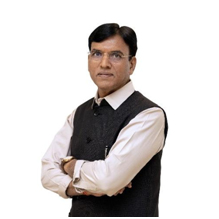
 Mansukh L Mandaviya Mansukh L Mandaviya
Very few long-serving Prime Ministers of Bharat have served as Chief Ministers in states. Most have been ‘national’ leaders, with little federal experience. Prime Minister Narendra Modi is one of the few exceptions.
When Shri Narendra Modi became Prime Minister in 2014, he brought with him a working philosophy sharpened by a decade of state-level governance in Gujarat. In those years, he closely observed why programmes failed or succeeded at the last mile, and refined an approach that made him the first Prime Minister to place execution, and not merely policy design, at the centre of governance. From electricity to banking, welfare to infrastructure, this philosophy has since redefined how the Indian state serves its citizens.
Execution Shaped by Experience
Shri Narendra Modi’s conviction in execution as the central through-line for policy can be seen in his approach to the power sector. In Gujarat, he observed that villages had poles and lines but lacked actual electricity. The solution was the Jyotigram Yojana, which separated feeders so that households had a 24 - hour supply and farms a predictable share. As Prime Minister, he scaled up this principle through the Deen Dayal Upadhyaya Gram Jyoti Yojana, providing reliable power to 18,374 villages. By 2023, that supply had become the backbone for the country’s MSMEs, which collectively employ over 110 million people and contribute nearly 29% of India’s GDP.
The same principles resurfaced in banking. On paper, rural families had bank accounts, but in practice, they lay dormant. Jan Dhan changed that. By integrating Aadhaar and mobile phones to individual bank accounts, what was a weak system became the bedrock for direct transfers that went on to reach citizens without middlemen, plugged leakages and saved the exchequer enormous sums.
Housing was next. The Pradhan Mantri Awas Yojana linked payments to construction milestones, used geo‑tagging to monitor them, and insisted on better design. For the first time, beneficiaries received complete and livable houses, reversing the trend of inaugurating unfinished shells of previous governments.
Federalism as a Force Multiplier
Gujarat also showed Shri Narendra Modi how progress depended on Centre–state alignment. At the national level, this became a philosophy of cooperative as well as competitive federalism.
The Goods and Services Tax, blocked for decades, was passed by brokering a consensus with states. The GST Council institutionalised fiscal negotiation and created a unified national market.
Beyond these, he expanded the share of central taxes devolved to states. This gave them greater fiscal room and autonomy in shaping their priorities. At the same time, he promoted competitive federalism by ranking states on ease of doing business and rewarding reform. These shifts encouraged states to act not only as recipients of funds but as stakeholders in Bharat’s growth story.
In infrastructure, Gujarat’s BISAG mapping experiments were scaled into PM Gati Shakti, where 16 ministries and all states now plan 1,400 projects on a single digital platform, cutting approval times and harmonising execution.
Welfare as Productivity
For Shri Narendra Modi, welfare schemes were always productivity investments meant to empower their recipients. Gujarat’s enrolment drive, Kanya Kelavani, lifted female literacy from 57.8% in 2001 to 70.7% by 2011. Nationally, this translated into the Beti Bachao, Beti Padhao programme, which has been linked to improvements in the child sex ratio from 918 in 2014 to 934 by 2023. Keeping girls in school delayed marriage, improved their health, and raised long-term productivity, enabling them to enter the paid workforce and thereby participate more effectively in nation-building.
Maternal health was treated with the same care. Gujarat’s Chiranjeevi Yojana subsidised institutional deliveries, thereby reducing mortality. At the Centre, the Pradhan Mantri Matru Vandana Yojana added maternity benefits and nutrition, supporting more than three crore women. The guiding idea was consistent: social spending should reduce vulnerability, expand choice, and raise future workforce capacity.
Investor and Citizen Confidence
Perhaps, the most subtle impact of the Gujarat Model is a mindset shift. The Vibrant Gujarat summits showed how consistent engagement could alter perceptions, turning a state into a credible investment destination in the eyes of investors and making bureaucrats business-friendly. It is this experience that shaped Make in India, which prioritised predictability via streamlined clearances, land corridors, and infrastructure readiness. Between 2014 and 2024, India attracted ₹83 lakh crore of Foreign Direct Investment (FDI), signalling confidence in its execution capacity and long-term reliability.
Expectations shifted at the citizen level as well. Earlier, schemes were judged by announcements. Today, ordinary Indians assume government-backed essentials, electricity, toilets, bank accounts, subsidised gas, will actually reach them. That quiet normalisation of delivery has created a political culture where promises are measured by their execution, not intent. In many ways, this raised expectation is the Gujarat Model’s deepest legacy.
Towards Viksit Bharat 2047
Sabka Saath, Sabka Vikas, Sabka Vishwas, Sabka Prayas is not rhetoric. Its imprint is visible in daily realities: electricity no longer a luxury, welfare delivered directly, infrastructure planned with digital coordination, health and education designed for measurable outcomes rather than optics. This is now the Bharatiya Model that has taken governance to the very last mile, touching lives in every corner of the nation.
When Bharat will achieve its ambition of becoming a Viksit Bharat by 2047, it will be because one Prime Minister redefined governance itself. By making execution the test of administration, he has turned Bharat’s vast machinery from promise into delivery. That imprint, first trialed in Gujarat and then scaled nationally, is Shri Narendra Modi’s decisive legacy.
Author is the Union Minister for Labour Employment, Youth Affairs and Sports |
