 Early Times Report Early Times Report
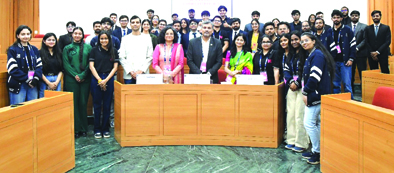
JAMMU, Feb 14: Indian Institute of Management Jammu, executed the Hult Prize 2026 Campus Round, a globally acclaimed social entrepreneurship competition widely regarded as the "Nobel Prize for Students." The event was inaugurated by Dr. Malaya Ranjan Mohapatra, Chairperson, International Relations, who emphasized the importance of innovation-driven social impact and sustainable entrepreneurship for the next generation of leaders.
Aligned with the United Nations Sustainable Development Goals (SDGs), this year's theme, Innovation that Drives Sustainable Transformation, encouraged student teams to conceptualize scalable solutions creating measurable social, environmental, and economic impact. The competition unfolded across three intensive rounds: an SDG-focused quiz, business idea evaluation, and the final Business Model Pitch, generating high levels of enthusiasm and participation across MBA, HAHM, and IPM cohorts.
The final round, held on 14 February 2026, showcased compelling presentations by shortlisted teams. Each team pitched innovative solutions designed to tackle real-world challenges while remaining financially and socially sustainable.
The esteemed jury comprised Dr. Swati Rajendrakumar Khade, Founder & Chairperson, Beautiful Tomorrow Foundation; Dr. Rashi Taggar, Assistant Professor, Shri Mata Vaishno Devi University; and Shri Vishal Dev, Director - Sustainable Business, WWF India.
This year's edition witnessed a diverse spectrum of solutions:
Team Spartans introduced Agriloop, a circular nutrition model that converts everyday food waste into affordable nutrition-simultaneously feeding children, generating income for farmers, and reducing food system inefficiencies. Team INDUSTRIX presented an AI-powered distributed manufacturing platform that transforms idle factory machines into a coordinated production grid, unlocking unused industrial capacity and enabling small workshops to operate at enterprise scale.
Team New Frontier showcased VoltNode, a decentralized solar energy sharing ecosystem leveraging IoT, AI, and blockchain to facilitate peer-to-peer microgrids and empower prosumers to trade surplus energy efficiently. Team Project Ushana proposed PCM-based roofing insulation solutions tailored for low-income households in and around Jammu, offering affordable thermal regulation and improved living conditions. |
