 Early Times Report Early Times Report
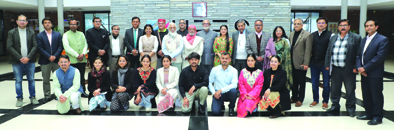
DEHRADUN, Feb 18: UPES, in collaboration with HESCO, organised a national-level Expert Workshop on Environmental Education, bringing together academic leaders, sustainability experts and policymakers to shape a robust, actionable 'curriculum framework' for embedding sustainability across Indian higher education. Designed as a high-impact, outcome-oriented 'build room' rather than a conventional seminar, the workshop focused on reimagining environmental education as a practical, interdisciplinary competency. The deliberation focused on moving beyond textbook awareness to enabling measurable student competencies rooted in India's ecological realities and development priorities.
Central to the discussions was a national imperative: as India advances growth, climate resilience and sustainability transitions, higher education must equip students to balance ecology and economy. Participants endorsed a nature-led, experiential, locally anchored curriculum connecting learners to air, water, soil, forests and ecosystems through real problem-solving, field immersion and community-linked learning, tailored to regional environmental realities.
The program commenced with an inaugural address by one of the most trusted voices on sustainability - Dr Anil Prakash Joshi, Founder of HESCO, followed by a welcome and institutional overview from Dr Sunil Rai, Vice-Chancellor, UPES. The Chief Guest, Dr Anil D. Sahasrabudhe, Chairman, NAAC, delivered a keynote address, highlighting the alignment of the workshop's recommendations with national quality frameworks and the broader transformation of curricula. The workshop brought together a strong cross-section of education and sustainability leadership, including Dr Rajendra Shende, Founder Director, TERRE Foundation; Dr Dharam Buddhi, Vice-Chancellor, Uttaranchal University; Prof Bineesha Payattati, Executive Director, MRAI and IIWM; Dr Sanjay Jasola, Vice-Chancellor, DBS Global University; Prof Naveen Kumar Nawani, Dean-Bio Sciences, IIT Roorkee; Prof Dr Himanshu Arora, Vice-Chancellor, Subharti University; Dr Shalini Bhalla, Managing Director, ICCE; Kamal Ahuja, Principal, The Doon School; Dr Manoj Panda, Director, WIT.
The deliberations focused on making environmental education a core, application-driven discipline across programs, with region-specific learning pathways reflecting India's ecological diversity-from Himalayan fragility to urban air pollution and water scarcity. A key theme was institutionalising solution-oriented skills, enabling students to identify local issues, design context-relevant interventions, and measure impact, so sustainability becomes an essential professional capability across governance, industry, entrepreneurship and community leadership. |
