 Early Times Report Early Times Report
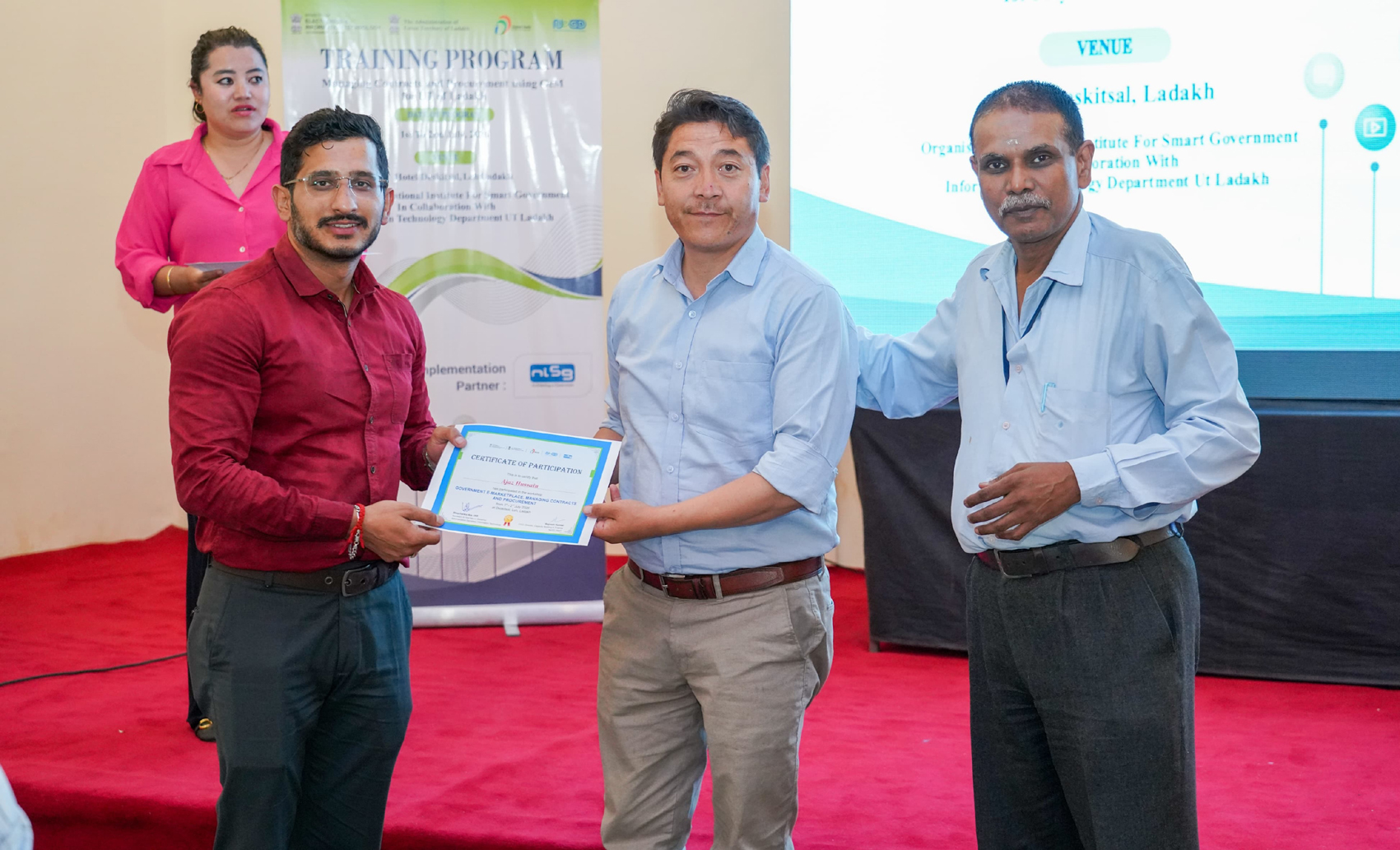
LEH, July 2: The programme was organised by the National Institute of Smart Government (NISG) in collaboration with the Information Technology Department, Union Territory of Ladakh. It brought together officers and officials from various government departments with the objective of enhancing their knowledge and skills in digital public procurement, contract management, and the effective use of the Government e-Marketplace (GeM) platform.
The technical sessions on the second day were conducted by G. Chamu, Senior General Manager (SGM), National Institute of Smart Government (NISG), who delivered detailed presentations on various aspects of procurement planning, contract management, and digital governance projects.
The first session focused on the Introduction to Digital Governance Project Lifecycle, covering the different stages of project planning and procurement in digital governance initiatives. Participants also shared their experiences and engaged in peer learning and discussions on procurement-related challenges and best practices.
The second session dealt with Standard Contracts, highlighting the essential elements of a contract, key contractual clauses and their significance, various contract models including Time & Material (T&M), Fixed Bid, Service Level Agreements (SLAs), Outsourcing and Public-Private Partnership (PPP) models. The session also explained major components of procurement contracts, pricing and payment mechanisms, service level agreements, and non-disclosure agreements (NDAs).
The third session featured Procurement Case Study Discussions, providing practical insights into contract amendments, contract administration, dispute resolution mechanisms, contract closure procedures, service level management, and procurement of services under the Public-Private Partnership (PPP) model adopted by the Government of India.
The fourth session focused on Procurement Planning and Preparation of Request for Proposal (RFP) documents. Participants were introduced to the complete procurement process, including Expressions of Interest (EOI), Requests for Information (RFI), Requests for Proposal (RFP), and tender management.
The session also covered procurement strategies and principles, procurement planning, selection between single and multiple vendors, single-stage and two-stage procurement processes, and qualitative and quantitative methods for evaluating proposals. The programme concluded with an interactive question-and-answer session, allowing participants to clarify practical issues related to contracts and procurement. |
