news details |
|
|
| A tribute to Dr Shyama Prasad Mookerjee | | | 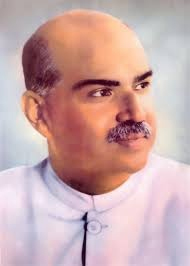 Ravi Rohmetra Ravi Rohmetra
Dr. Shyama Prasad Mookerjee was born in a Bengali hindu family on 6th July 1901 in Kolkota , the capital of British India. His father was Sir Ashutosh Mookerjee, a well respected advocate, well known as Bengal tiger, who became the vice chancellor of the university of Calcutta and his mother was lady Jogmaya Devi Mookerjee, Shyama Prasad Mokeerjee grew up to be “ an Introvert” rather insular a reflective person, also an emotional person.” who needed someone else by his side to give him emotional support. He was seriously affected by the early death of his wife Sudha Devi and never remarried or sink in grief. Mookerjee graduated in English securing the first position in first class in 1921 and also did M.A in 1923 and BL in 1924 . he became a fellow of the senate in 1924 after his father’s death .subsequently, he left England in 1926 to study at Lincoin;s INN and became a Barrister in 1927. At the age of 33 years Mookerjee became the youngest Vice Chancellor of the University of Calcutta and held the office till 1938. He enjoyed only eleven years of married life and had five children. He was elected as member of the Legislative council of Bengal , as an Indian National Congress candidate representing Calcutta university but resigned next year when congress decided to boycott the legislature Mookerjee started his political career in a small way in 1929 as a legislative counsil. Subsequently, he contested the election as an independent candidate and got elected. He was the finance Minister of Bengal province during 1941-1942. He emerged as a spokesman for Hindus and shortly joined Hindu Mahasabha and in 1944. He became the President. He was political leader who felt the need to counteract the communalist and separatist Muslim League of Muhammad Ali Jinnah, who were demanding either exaggerated Muslim rights or a muslim state of Pakistan. He wanted Hindu Mahasabha not to be restricted to Hindus alone. Following the assassination of Mahatama Gandhi by a Hindu fanatic. The mahasabha was blamed chiefly for the heinous act and became deeply unpopular. Mookerjee himself condemned the murder and left the party. The then Prime Minister Jawahar Lal Nehru inducted him in the interim central Government as a Minister for Industry and supply. On issue of 1949 Delhi pact with Pakistani Prime Minister liyaqat Ali khan Mookerjee resigned from the cabinet on 6th april 1950. Mokkerjee was firmly against Nehru’s invitation to the Pakistani Prime Minister and their joint pact to establish minority commissions and guarantee minority rights in both countries. He wanted to hold Pakistan directly responsible for the terrible influx of millions of Hindu refugees from east Pakistan, who had left state fearing religious suppression and violence aided by the state. Mookerjee considered Nehru’s actions as appeasement and was hailed as a hero by the people of west Bengal. After consultation with shri Golwalkar Guru ji of RSS Shri Mookerjee founded Bharatiya Jana Sangh on October 21 1951 at delhi and he became the first president of it. In 1952 elections Bharatiya Jana sangh won 3 seats in Parliament of India including his seat. The Bhartiya Jana Sangh (BJS) also favoured a uniform civil code governing personal law matteres for both Hindu and Muslims wanted to ban cow slaughter and end the special status given to the Muslim – Majority state of Jammu and Kashmir . The BJS founded hindutva agenda which became the wider Political expression of India’s Hindu Majority.
He opposed the Indian National Congress’s decision to grant Kashmir a special status with each own flag and Prime Minister. According to congress’s decision, no one including the President of India could enter into Kashmir without the permission of Kashmir’s Prime Minister. In opposition to this decision , he once said “EK DESH MEIN” DO VIDHAN”, “DO PRADHAN “And “DO Nishan” nahi challenge “(A single country can’t have two constitutions, two Prime Ministers and two National Emblems) Dr. Shayama Prasad Mookeerjee went to visit Kashmir in 1953 and observed a hunger strike in protest the law that prohibited Indian Citizens from settling in a state within their own country and mandated that they carry ID cards Mookerjee wants to go to Jammu and Kashmir but because of the prevailing permit system , He was not given permission .He was arrested on 11th May while crossing border into Kashmir. Although the ID-card rule was revoked owing to his efforts , he died as detenu on 23rd June 1953 under mysterious circumstances.
Dr. Mookerjee was arrested on entering Kashmir on 11th May 1953 , Thereafter he was jailed in a dilapidated house. Dr. Shyama had suffered from dry pleurisy and coronary troubles and was taken to hospital one and a half months after his arrest due to complications arising from the same . He was administered Penicillin despite having informed the doctor –in- charge of his allergy to pencillin and he died on 23rd June 1953. No post mortem was ordered in total disregard of the rule . Maulana Azad , who was acting Prime Minister (in absence of Nehru , who was away in London) did not allow body to be brought to delhi and dead body directly flown to Calcutta . his death in custody raised wide suspicion across the country and demands for independent enquiry were raised, including earnest requests from his mother, Jagmaya Devi, to Jawahar lal Nehru, Nehru declared that he had enquired from a number of persons who were privy to the facts and according to him, there was no mystery behind Mookerjee’s death. His death therefore remains a matter of some controversy. Atal behari Vajpayee claimed in 2004 that the death of Mookerjee was a conspiracy. However it was Mookerjee Martyrdom, which later compelled Nehru to remove permit system , post of Sadar –e- Riayast at and of Prime Minister of Jammu and Kashmir. On 22 April 2010, Muncipal Corporation of Delhi’s newly constructed Rs 650 Crore building (The latest building in delhi) was named “ Doctor Shyama Prasad Mookerjee Civic Centre “ The Civic centre was inaugurated by then Home Minister P.Chidambaram . The building which will cater to an estimated 20,000 visitor per day will also house different wings and offices of the Muncipal corporation of Delhi (MCD) delhi also has a major road named after Dr. Shyama Prasad Mookerjee on 27 August 1998, the Ahmedabad Muncipal Corporation named a bridge after Mookerjee A best bus Junction near the chhatrapati Shivaji Museum (formerly the prince of Wales Museum) and Regal cinema in Mumbai is named as “ Shyama Prasad Mookerjee Chowk” in his honour . In 2001 , the main research funding institute of the government of India CSIR instituted a new fellowship named after him . The Shyma Prasad Mookerjee fellowship is the most prestigious fellowship given in india for doing PHD . only the top 20% students who clear the Junior Research Fellowship (JRF CSIR/UGC) are eligible to sit for this examination ,on 15 January 2012 . Mathikere flyover under Bangalore city Limits was inaugurated and named “ Dr. Shyama Parsad Mookerjee Flyover.”
“ We firmly believe that our plea for the full and complete intergration of Jammu and Kashmir with India is consistent with true nationalism and the needs for the security of India including Kashmir”
Dr. Shyama Parsad Mookerjee , First all India session of Bhartiya Jana Sangh at Kanpur on 29th Dec 1952
OPINION ON SPECIAL STATUS OF JAMMU AND KASHMIR
Mukherjee was strongly opposed to Article 370, seeing it as a threat to national unity. He fought against it inside and outside the parliament with one of the goals of Bharatiya Jana Sangh being its abrogation. He raised his voice strongly against the provision in his Lok Sabha speech on 26 June 1952. He termed the arrangements under the article as Balkanization of India and the three-nation theory of Sheikh Abdullah. The state was granted its own flag along with a prime minister whose permission was required for anyone to enter the state. In opposition to this, Mukherjee once said “Ek desh mein do Vidhan, do Pradhan aur Do Nishan nahi chalenge” (A single country can’t have two constitutions, two prime ministers, and two national emblems). Bharatiya Jana Sangh along with Hindu Mahasabha and Jammu Praja Parishad launched a massive Satyagraha to get the provisions removed. In his letter to Nehru dated 3 February 1953, he wrote that the issue of accession of Jammu and Kashmir to India should not be allowed to hang fire.clarification needed.
Mukherjee went to visit Kashmir in 1953 and observed a hunger strike to protest the law that prohibited Indian citizens from settling within the state and mandating that they carry ID cards. Mukherjee wanted to go to Jammu and Kashmir but, because of the prevailing permit system, he was not given permission. He was arrested on 11 May at Lakhanpur while crossing the border into Kashmir illegally. Although the ID card rule was revoked owing to his efforts, he died as a detainee on 23 June 1953 under claimed mysterious circumstances.
On 5 August 2019, when Government of India proposed constitutional Amendment to repeal Article 370, many newspapers described the event as realization of Syama Prasad Mukherjee’s dream
LEGEACY
One of main thoroughfare in Calcutta was renamed Syama Prasad Mukherjee Road on 3 July 1953 a few days after his death. Syamaprasad College founded by him in 1945 in Kolkata is named after him. Shyama Prasad Mukherji College of University of Delhi was established in 1969 in his memory. On 7 August 1998, the Ahmedabad Municipal Corporation named a bridge after Mukherjee. Delhi has a major road named after Mukherjee called Shyama Prasad Mukherjee Marg. Kolkata, too, has a major road called Shyama Prasad Mukherjee Road. In 2001, the main research funding institute of the Government of India, CSIR, instituted a new fellowship named after him. In 2014, a multipurpose indoor stadium built on the Goa University campus in Goa was named after Mukherjee.. On 12 January 2020, the Kolkata Port Trust was renamed as Syama Prasad Mukherjee Port by Prime Minister Narendra Modi. T he Chenani-Nashri Tunnel on NH44 in Jammu and Kashmir was renamed after Mukherjee by the Indian government in 2020
On 20th March 2010 Madopur Punjab at Ekta Sathal statue of Dr. Shyama Prasad Mookerjee was inaugurated and named after “Dr. Shyama Prasad Mookerjee” in his honour in the presence of RSS chief Sh. Mohan Jee Bhagwat” , Sh.L.K.Advani , Sh. Nitin Gadkari and Sukhveer Singh Badal .
A newly big building of BJP Office is constructed in Trikuta Nagar Jammu (the Tallest building) named as “ Shyama Prasad Mookerjee Bhawan” in his honor. |
|
|
|
|
|
|
|
|
|
|
|
|
| |
| |
|
|
|
|
 |
|
|
