 Early Times Report Early Times Report
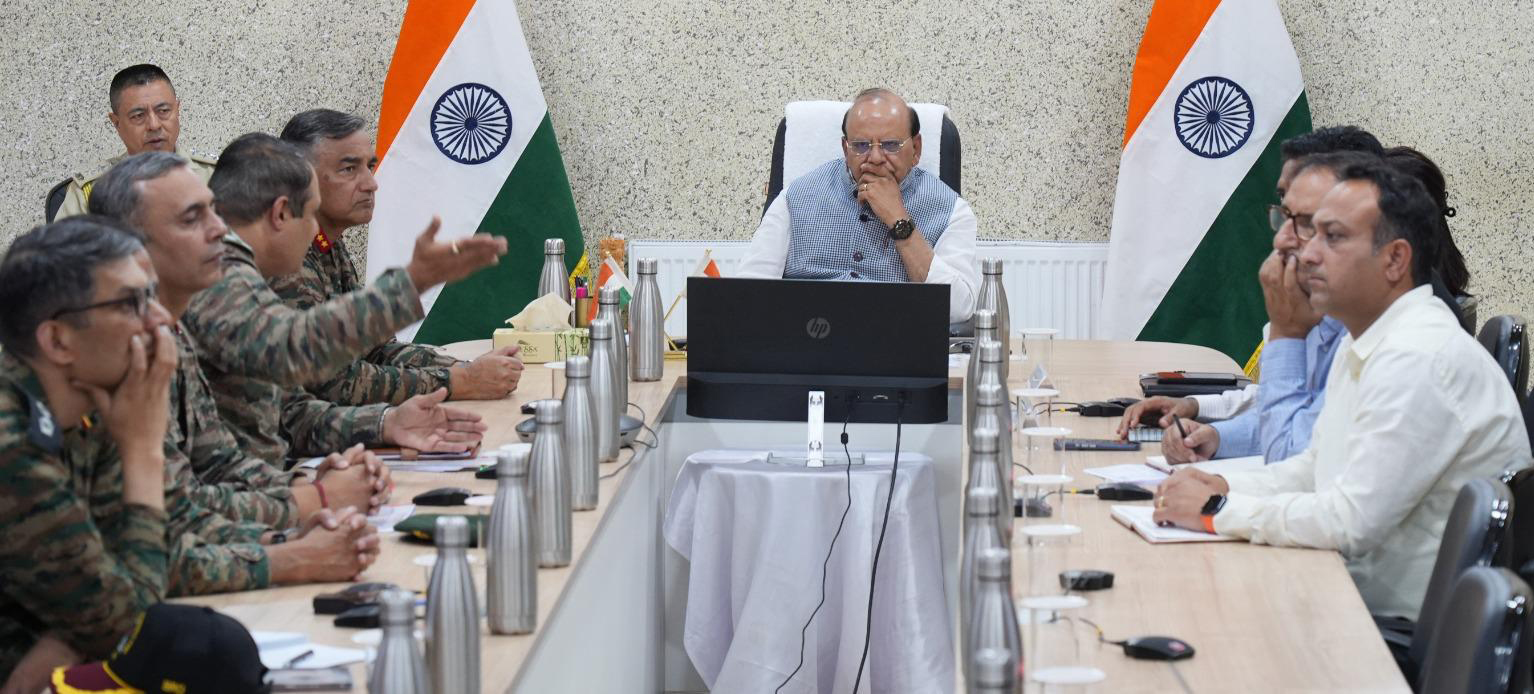
LEH, Aug 7: In the wake of recent incidents of landslides and rockfalls that damaged property of villagers and disrupted traffic on national highways, Lieutenant Governor, Shri Vinai Kumar Saxena, yesterday held a high-level meeting to review preparedness and mitigation measures. The meeting involving the Indian Army, Border Roads Organisation (BRO) and the UT Administration also focused on minimising the impact of such incidents and preventing avoidable disruptions in the future.
The meeting was attended by GOC 14 Corps, Lt Gen Madanraj Pande, along with Chief Engineer, HQ 14 Corps, Brig. Aditya Harshey, Chief Engineer, Project Vijayak, Brig. Rahul Oberoy and Chief Engineer, Project Himank, Brig Rajiv Ahlawat, apart from the Secretary, PWD, UT Administration.
The Lieutenant Governor lauded the relief assistance provided by the Army and BRO during flash floods and landslides, and expressed satisfaction with the prompt road-clearance operations following landslides. He, however, stressed the need for immediate proactive measures at vulnerable locations to prevent recurrence of such incidents and ensure uninterrupted connectivity.
Shri Saxena directed the concerned agencies to undertake a detailed safety audit of vulnerable stretches, particularly around 15 identified high-risk locations along the Leh-Kargil National Highway and at least 4 - 5 vulnerable points along the Khardung La on Leh-Nubra road. The LG emphasised the need to assess unstable slopes and, wherever necessary, remove loose and potentially hazardous rocks before they pose a threat to road users.
L-G Shri Saxena stressed that the objective should be to move from reactive response to proactive risk assessment, engineering and technology-based mitigation, ensuring safer roads, uninterrupted connectivity and greater resilience against natural hazards in Ladakh.
"The recent flash floods, landslides and rock falls have once again underlined the need to strengthen our preparedness and move beyond reactive response to proactive prevention. I have directed the concerned agencies to identify vulnerable locations, undertake detailed safety audits and use the best available technologies for slope stabilisation and rockfall protection. Our priority is to ensure the safety of people, protect critical infrastructure and maintain uninterrupted connectivity across Ladakh," said L-G Saxena.
They also briefed the LG on available mitigation technologies, including retaining and breast walls, flexible ring nets for debris protection, soil nailing, rock bolting and anchoring, and shored-wall retaining structures. For rockfall protection, measures such as rockfall embankments, rock sheds, high-energy absorption barrier systems and smart rockfall detection systems can be deployed. The use of geosynthetics, including geogrids, geotextiles, geomembranes and geocells, was also discussed in the meeting. |