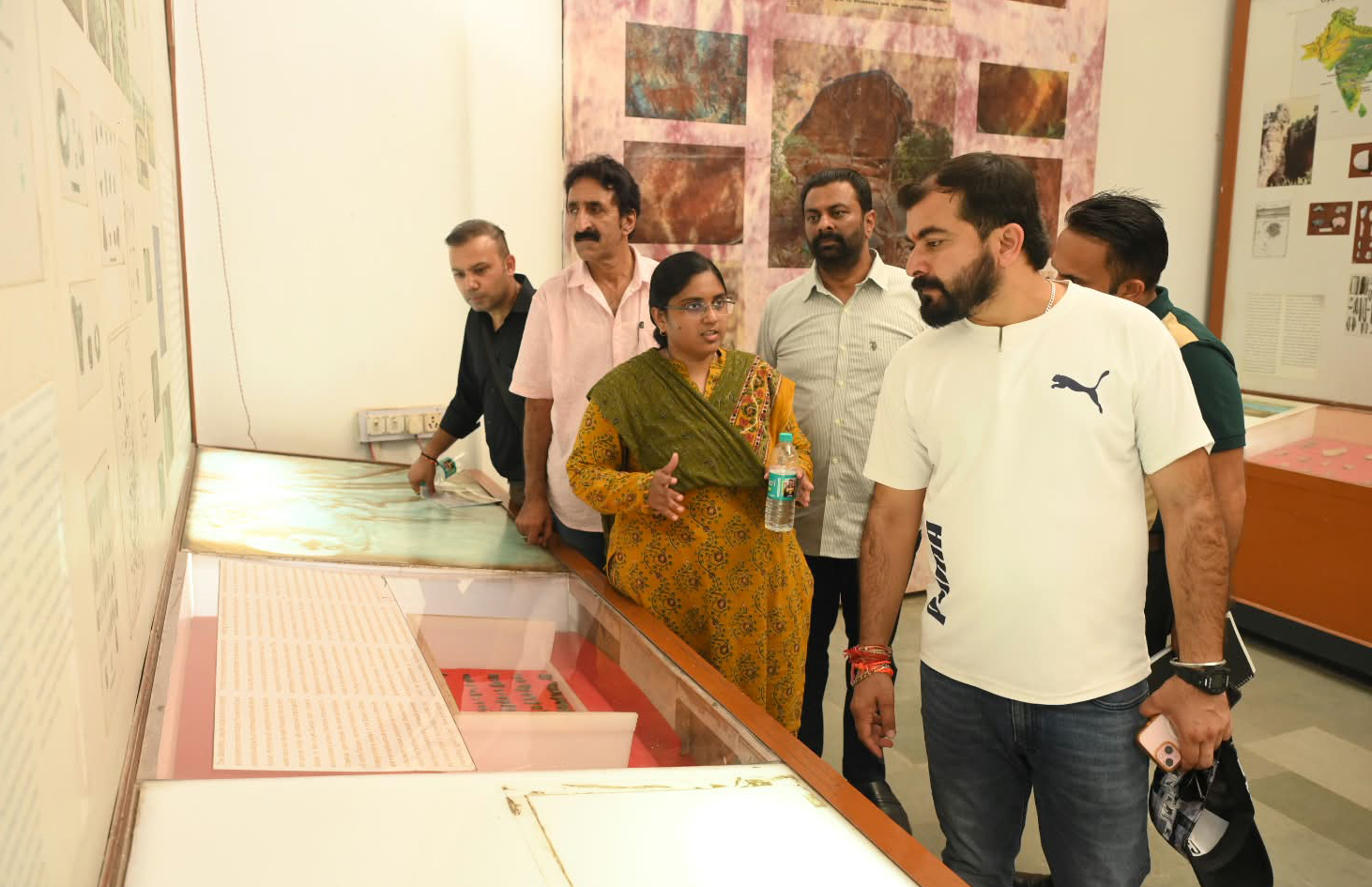
 BHOPAL, Sept 16: On the third day of the media tour to Bhopal organised by Press Information Bureau, Jammu, a delegation of 10 journalists, visited the Indira Gandhi Rashtriya Manav Sangrahalaya (IGRMS) to explore its unique presentation of India's rich tribal and rural cultural heritage. BHOPAL, Sept 16: On the third day of the media tour to Bhopal organised by Press Information Bureau, Jammu, a delegation of 10 journalists, visited the Indira Gandhi Rashtriya Manav Sangrahalaya (IGRMS) to explore its unique presentation of India's rich tribal and rural cultural heritage.
During the visit, the journalists were introduced to the museum's extensive open-air and indoor exhibitions, which offer visitors an opportunity to understand India's diverse cultural traditions, lifestyles, architecture, crafts and social practices. The delegation visited the Indoor Exhibition - Veethi Sankul, housed in a dome-shaped structure and comprising 12 galleries with varied themes. A prominent gallery on the Bio-Cultural Evolution of Man presents information on humans as physical beings and traces the evolutionary journey from prehistoric times to the contemporary age through models, graphics, sketches, showcases and panels.
The remaining galleries showcase the diverse cultures of tribal and rural India, featuring approximately 6,678 ethnographic objects displayed under different themes. The Visual Storage and Research Gallery provides research opportunities for students, authors, documentary filmmakers and others interested in studying India's cultural heritage. The delegation also learnt about IGRMS's wide range of educational and cultural activities, including seminars, conferences, workshops, cultural programmes and regional cultural festivals.
Later, the delegation visited the Tribal Museum (Janjatiya Sangrahalaya), an institution dedicated to showcasing and preserving the cultural heritage of the tribal communities of Madhya Pradesh and other parts of India. During the visit, Manager Tribal Museum, Sanjay Mehar, briefed the visiting journalists about the museum's exhibits, their historical and cultural significance, and the efforts being made to document and preserve the traditions and heritage of tribal communities.
The journalists toured various galleries and displays of the museum, which offer a detailed portrayal of the traditional lifestyles, customs, beliefs, festivals, art forms, architecture, crafts and cultural practices of different tribal communities. -
The visit enabled the journalists to gain a deeper understanding of the importance of preserving intangible cultural heritage, including traditional knowledge, folk traditions, craftsmanship, music, dance, rituals and community practices. The exhibits demonstrated how museums can serve not only as repositories of historical objects but also as important platforms for educating visitors and creating greater awareness about India's diverse cultural traditions. |
