 Early Times Report Early Times Report
JAMMU, Sept 25: AIIMS Jammu has successfully performed a complex craniovertebral junction (CVJ) stabilization surgery on a nine-year-old child with recurrent strokes, marking an important advancement in the institute's capability to manage challenging pediatric spine and skull-base disorders. The child has recovered well and has resumed attending school.
The child initially presented with recurrent episodes of stroke-like neurological symptoms and was evaluated by the Department of Pediatrics at AIIMS Jammu. Detailed clinical and radiological assessment revealed compression of one of the vertebral arteries, a major blood vessel supplying the back portion of the brain, due to instability in the upper cervical spine. The child was referred to the Department of Neurosurgery, where detailed assessment and surgical planning were undertaken. The neurosurgical team subsequently performed fixation between the skull and upper cervical vertebrae to stabilize the craniovertebral junction, protect the vertebral artery and reduce the risk of further neurological events.
Dr. Shaurya Darbari, Officiating Head and Associate Professor, Department of Neurosurgery, performed the surgery with Dr. Kanav Gupta, Assistant Professor, Department of Neurosurgery. The procedure and postoperative recovery were uneventful, and the child has returned to school.
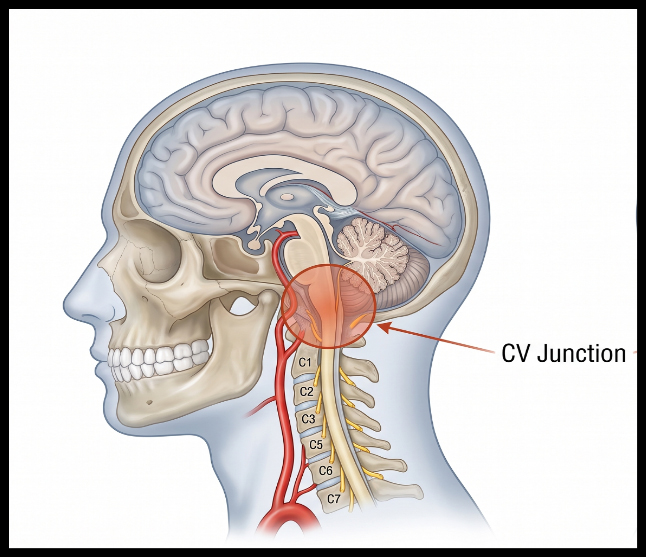
The craniovertebral junction is the region where the base of the skull meets the upper cervical spine and contains the lower brainstem, upper spinal cord, important nerves and vertebral arteries. Disorders affecting this region can cause serious neurological problems due to instability or compression of these critical structures. While many such abnormalities are congenital, symptoms may appear later and can include neck pain, headache, dizziness, imbalance, weakness, difficulty walking and, in rare cases, neurological episodes or stroke.
Dr. Shaurya Darbari, said that CVJ surgery requires exceptionally careful planning because of the close proximity of the brainstem, upper spinal cord and vertebral arteries. "In children, the small size of the bones and congenital variations can make these procedures particularly demanding. Early diagnosis, detailed imaging, appropriate instrumentation, careful positioning and close coordination between the surgical and anaesthesia teams are essential for safe outcomes."
The Department of Paediatrics, with Dr. Samriti Gupta, Officiating Head and Associate Professor, played a key role in the early evaluation and initial management of the child before referral for definitive neurosurgical treatment. The case also required specialized anaesthesia support from Dr. Raksha Kundal, Additional Professor; and Dr. Sandeepika Dogra, Associate Professor, Department of Anaesthesia. Anaesthesia management in patients with CVJ instability requires careful airway planning and minimal neck movement during intubation to avoid worsening instability or pressure on the spinal cord and brainstem. |
