 Early Times Report Early Times Report
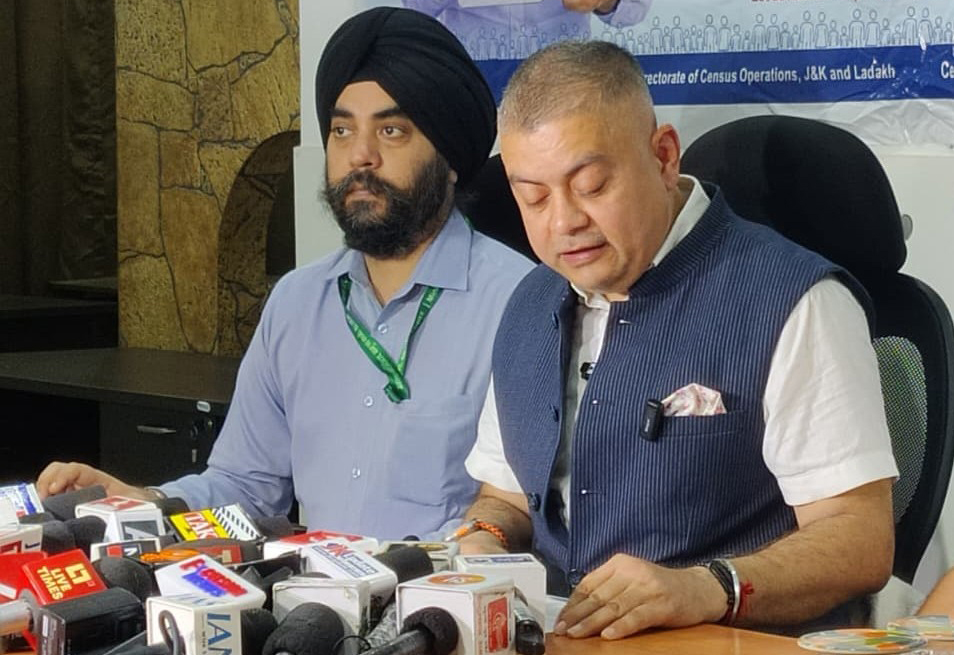
JAMMU, Oct 6: As part of Census 2027, Population Enumeration has been successfully completed in the designated snow-bound areas of Jammu & Kashmir and Ladakh, covering 5,292 Enumeration Blocks (EBs) including 4,597 in Jammu & Kashmir and 695 in Ladakh, involving enumeration across remote and difficult-to-access areas requiring extensive preparation, specialised field arrangements and close coordination with district administrations and Special Charges. This was stated by Chief Principal Census Officer (CPCO) and Director Census Operations (DCO), Jammu & Kashmir and Ladakh, Shri Amit Sharma who described the successful completion as a significant milestone in the preparations for Census 2027.
Addressing a press conference, Shri Sharma said that the snow-bound Population Enumeration was preceded by the Self-Enumeration phase, conducted from 17 to 31 August 2026, followed by field enumeration from 1 to 30 September 2026. In Ladakh, the September exercise covered the entire Union Territory, with Population Enumeration completed in all 695 Enumeration Blocks (EBs)-367 in Leh and 328 in Kargil. With this, Ladakh has become the first Union Territory in the country to complete Population Enumeration for Census 2027.
In Jammu & Kashmir, the snow-bound Population Enumeration covered 16 districts and 95 Charges. Doda recorded the highest number of completed Enumeration Blocks (EBs) at 798, followed by Kishtwar with 602, Ramban with 418, Anantnag with 377 and Baramulla with 359. Reasi and Udhampur completed 345 and 313 EBs, respectively. Kishtwar, which was declared fully snow-bound, has become the first district in the country to complete Population Enumeration for Census 2027.
CPCO appreciated the coordinated efforts of district administrations, Census functionaries, Special Charges, Enumerators and Supervisors, as well as the cooperation extended by residents. He said the successful completion of enumeration across difficult and remote terrain reflected the preparedness of the Census machinery and the effectiveness of field-level arrangements tailored to areas where geographical and climatic conditions necessitate a separate enumeration schedule.
The field operation was supported by extensive preparatory work, including the deployment of Nodal Officers and District Coordinators for field training, preparation and demarcation of Enumeration Blocks, distribution of Census kits and ensuring timely availability of prescribed manuals at the Charge level.
The exercise also received close attention from the senior leadership of the Census organisation. Mritunjay Kumar Narayan, IAS, Registrar General and Census Commissioner, India, undertook visit to J&K in August and his maiden visit to Ladakh during September to personally review the implementation and progress of Population Enumeration in the snow-bound areas. Additional Registrar General, Sunil Kumar, visited J&K during the preparatory phase in August. Both senior officers expressed satisfaction with the progress of preparations, training and field operations.
Briefing the media persons, Shri Sharma also shared that the Office of the Registrar General & Census Commissioner, India also deputed observers to monitor the Population Enumeration in snow-bound non-synchronous areas. The observers examined adherence to Census instructions and timelines, functioning of digital applications and devices, operational issues, respondent cooperation and the quality and progress of fieldwork, besides interacting with Principal Census Officers, Charge Officers, Supervisors and Enumerators. Their field visits established the smooth conduct of the exercise and the officers from Delhi appreciated the timely completion of training, EB formation, distribution of materials, fieldwork and publicity activities.
An important part of the exercise was the enumeration in Special Charges. Population Enumeration was completed in 125 Special Charges of Defence and CAPFs in the snow-bound areas of Jammu & Kashmir and 47 Special Charges in Ladakh. Dedicated arrangements were put in place for these locations, including the use of paper schedules, with operational queries addressed in real time. The concerned forces extended full support and supervision, while digitisation of the collected data is currently underway. |
