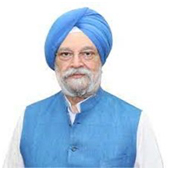
 Hardeep S Puri Hardeep S Puri
Rome was not built in a day, and neither will be the New Urban India. But even as we demand more from our cities, we must also pause to acknowledge the distance we have already travelled. For decades after Independence, India’s urban spaces were an afterthought. Nehru’s fascination with Soviet-style centralisation gave us the likes of Shastri Bhavan and Udyog Bhavan, concrete monoliths already crumbling by the 1990s, monuments to bureaucracy rather than service.
By the 2010s, central Delhi presented a dismal sight: potholed avenues, drab and leaking government buildings, and peripheral roads in NCR that were hopelessly jammed. Expressways were scarce, metros were confined to a handful of cities, and civic infrastructure was visibly decaying. A country aspiring to global leadership had a capital city that reflected only neglect.
Prime Minister Narendra Modi changed that trajectory. He placed cities at the heart of the national development agenda, treating them not as burdens to be managed but as engines of growth and symbols of pride. The transformation is visible everywhere. The Central Vista redevelopment turned Kartavya Path into a people’s space, the New Parliament into a future-ready institution, and Kartavya Bhawan into a streamlined hub for governance. Where once there was decay, there is now ambition and confidence.
The scale of this change is backed by numbers. Between 2004 and 2014, cumulative central investment in India’s urban sector was around Rs 1.57 lakh crore. Since 2014, that figure has risen to nearly Rs 28.5 lakh crore, a sixteenfold increase. In Budget 2025–26 alone, the Ministry of Housing & Urban Affairs was allocated Rs 96,777 crore, with one-third for metros and a quarter for housing. This unprecedented financial commitment is reshaping the urban fabric at a pace never seen before in independent India.
India’s broader economic and digital surge amplifies this momentum. Today, we are the world’s fourth-largest economy at roughly $4.2 trillion, with digital rails powering everyday life. UPI just crossed 20 billion transactions in a single month and handles over Rs 24 lakh crore in value monthly. Over 900 million Indians are now online, and 56 crore Jan Dhan accounts anchor the JAM trinity that delivers subsidies directly and transparently. This scale of formalisation and fintech adoption is uniquely Indian, and profoundly urban in its impact.
The metro revolution illustrates the transformation on the ground. In 2014, India had about 248 km of operational metro across five cities. Today, over 1,000 km span more than 23 cities, carrying more than one crore passengers daily. Dozens of new corridors are under construction, from Pune and Nagpur to Surat and Agra, making urban commutes faster, cleaner and safer. This is not just steel and concrete; it is reduced travel times, cleaner air, and millions of hours of productivity returned to citizens.
Urban connectivity has been rewritten. NCR’s choked peripheries are being decongested by the newly inaugurated UER-II, Delhi’s third ring road, linking NH-44, NH-9 and Dwarka Expressway to ease traffic at chronic bottlenecks. India’s first Regional Rapid Transit System, the Delhi–Meerut RRTS (NaMo Bharat), is already running on major sections and nearing full commissioning, slashing end-to-end travel to under an hour. These high-speed, integrated systems are defining a new metropolitan logic for a new India.
Expressways are recasting inter-city movement. The Delhi–Mumbai Expressway, the Bengaluru–Mysuru Expressway, the Delhi–Meerut access-controlled corridor, and the Mumbai Coastal Road are shortening distances and cleaning city air by taking long-haul traffic out of local streets. Atal Setu in Mumbai, the nation’s longest sea bridge, now seamlessly connects the island city to the mainland. The Mumbai–Ahmedabad high-speed rail, India’s first bullet train corridor, is advancing apace and will anchor a Western growth spine.
Inclusion has remained central. PM SVANidhi has extended collateral-free credit and digital empowerment to over 68 lakh street vendors, helping micro-entrepreneurs rebuild livelihoods and enter the formal economy. PM Awas Yojana (Urban) has sanctioned more than 120 lakh houses, with about 94 lakh already completed. Millions of families once confined to slums now live in secure pucca homes. These are not just statistics; they are transformed lives and aspirations unlocked.
Energy reform is improving daily urban life. Where kitchens once depended on costly and uncertain cylinder bookings, piped natural gas (PNG) is increasingly the norm, safer, cleaner and more convenient. City Gas Distribution has expanded from just 57 geographical areas in 2014 to over 300 today. Domestic PNG connections have risen from about 25 lakh to over 1.5 crore, while thousands of CNG stations power cleaner public transport. Turning a tap for fuel is now a reality for millions of urban homes.
India has built the confidence to host the world. Bharat Mandapam successfully hosted the G20 Leaders’ Summit. Yashobhoomi has emerged among the largest convention complexes globally, capable of welcoming tens of thousands of delegates. India Energy Week has drawn the global energy ecosystem to Bengaluru, Goa and New Delhi, signalling that our cities can convene the world at scale and with style. None of this would have been imaginable when dilapidated halls and crumbling stadia defined our civic infrastructure.
Transport modernisation is happening at scale and speed. Operational airports have more than doubled, from 74 in 2014 to about 160 today, thanks to UDAN and sustained investments. Vande Bharat now runs on over 140 services, cutting travel times across regions. Over 1,300 railway stations are being modernised under the Amrit Bharat Station Scheme, with more than a hundred already inaugurated. In Delhi, the expanded Terminal-1 has lifted IGI’s capacity past 100 million passengers per annum, putting our capital in the global big league.
Sensible tax policy supports consumers and growth. The recent GST rationalisation moves most goods and services into 5% and 18% slabs, with steep rates reserved only for select sin and luxury items. Essentials from personal-care items to many household durables have seen rate cuts; small cars and two-wheelers now attract lower GST; several medicines and medical devices have become cheaper. For urban households, this means lower monthly bills, stronger consumption and a virtuous cycle of investment and jobs.
Having represented India abroad for decades as a diplomat, I saw firsthand how cities serve as the face of a nation. Vienna’s Ringstrasse, New York’s skyline, or the boulevards of Paris all embodied national ambition. It was clear to me that global perception begins in urban spaces. This conviction has guided my work in urban affairs: to ensure that Delhi, Mumbai, Bengaluru, Ahmedabad and our other cities reflect the confidence, modernity, and aspirations of a rising India. Just as my diplomatic career taught me the value of projecting India’s image internationally, my ministerial role has been to make our cities worthy of that image.
This is the arc of transformation: from post-Independence neglect to Modi-era modernisation. From Shastri Bhavan’s decay to Kartavya Bhawan’s ambition. From potholed roads to expressways and high-speed corridors. From smoke-filled kitchens to piped natural gas. From slums to millions of Pucca homes. From crumbling halls to world-class convention centres. From a hesitant capital to a confident global host.
India’s ancient cities like Pataliputra and Nalanda once embodied the heights of urban civilisation. Today, under Prime Minister Modi, Indian cities are again on that path, modern yet humane, ambitious yet inclusive, global in outlook yet rooted in our values. New Urban India is not being built in a day. But it is being built every day, brick by brick, train by train, home by home. And it is already transforming the lives of millions.
The writer is the Union Minister for Petroleum & Natural Gas |
