 Early Times Report Early Times Report
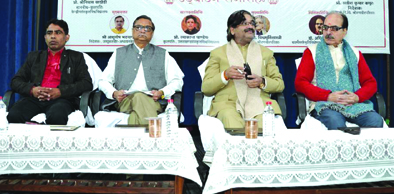
JAMMU, Feb 5: As part of the preparatory initiatives for the forthcoming AI Impact Summit 2026 under the India AI Mission, the Department of Computer Science and Natural Language Processing (NLP), Shri Ranbir Campus of Central Sanskrit University, New Delhi, organized a comprehensive academic program on artificial intelligence at the Vanivilas Auditorium on Tuesday.
The program was chaired by the Director of the Campus, Prof. Satish Kumar Kapoor, while the event was held under the patronage of the Vice-Chancellor of Central Sanskrit University, Prof. Shrinivas Varkhedi. The session was coordinated by Akhil Sharma and Neha Choudhary.
The keynote address was delivered by the Resource Person, Dr. Shefali Parihar, Assistant Professor, Indus University, Ahmedabad, who provided an in-depth overview of the core AI techniques and traced the historical evolution of artificial intelligence from its beginnings in the mid-1960s to its contemporary applications. She elaborated on the progressive developments in robotics, machine learning, deep learning, computer vision, and natural language processing, highlighting how these domains are collectively shaping the modern technological ecosystem.
Dr. Parihar also discussed the current role of AI in automation and job redefinition, addressing common myths regarding AI replacing human employment. She emphasized that rather than eliminating jobs, AI is transforming job structures and creating a growing demand for new skill sets. The lecture stressed the importance of AI literacy, critical thinking, and problem-solving skills, along with a strong focus on soft skills and human-AI collaboration.
The session further explored emerging opportunities in AI-driven startups and corporate sectors, encouraging students and faculty to pursue AI-related education and continuous learning to remain adaptable in a rapidly evolving job market. Participants were advised to develop a mindset of lifelong learning in order to effectively align with the changing skill requirements of the 21st century.
The program witnessed active participation from all Heads of Departments, faculty members, non-teaching staff, and students of the campus, making it a significant academic engagement in the university's roadmap towards technological integration. |
