news details |
|
|
| KVK Reasi promotes solar fencing system in Monkey prone areas | | | 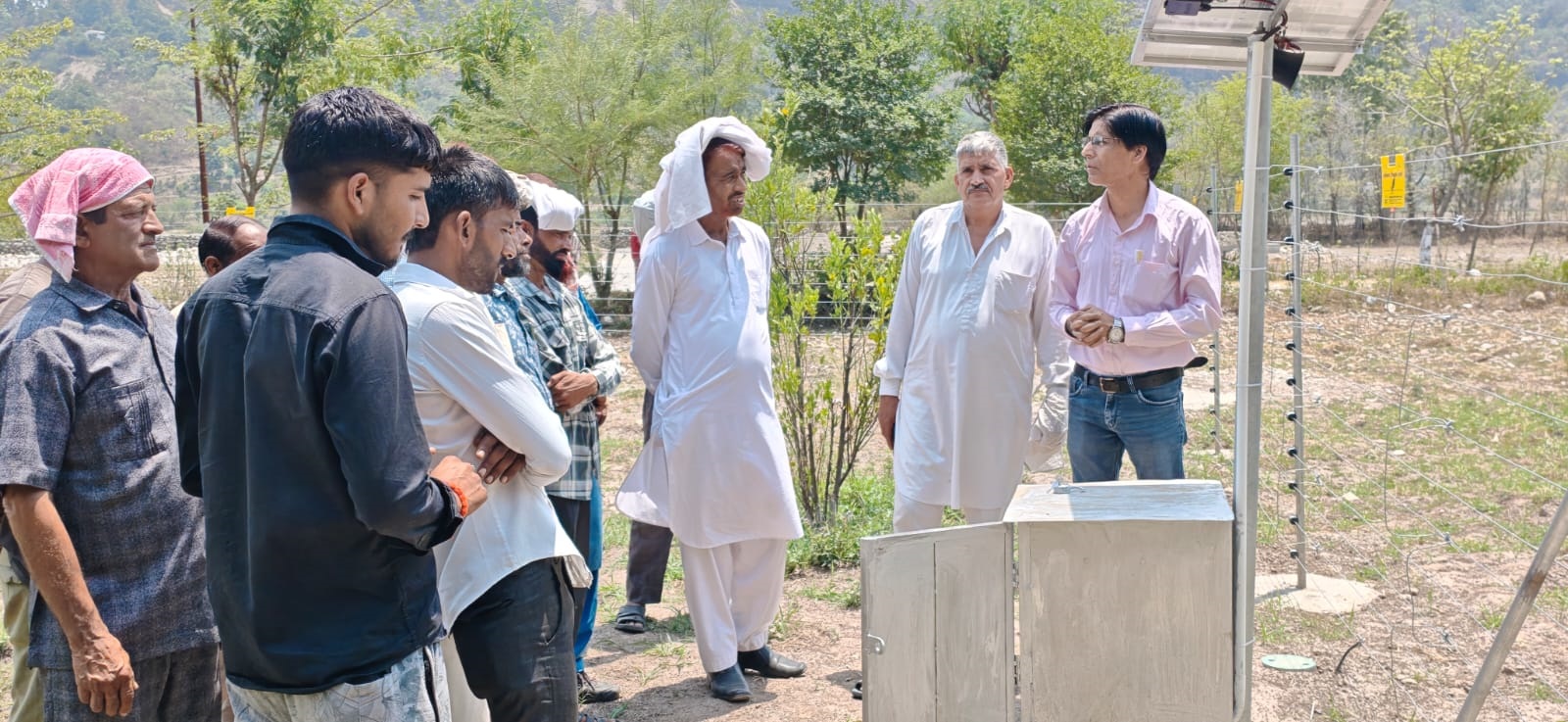 Early Times Report Early Times Report
Reasi, July 4: Krishi Vigyan Kendra (KVK), Reasi under the administrative control of Sher-e-Kashmir University of Agricultural Sciences and Technology-Jammu (SKUAST-J) has established a solar fencing system at its campus and is promoting this system among the farmers to protect the crops from monkey menace and other wild animals. KVK Reasi is working under the dynamic laederdship of Hon’ble Vice Chancellor, Prof. B.N. Tripathi and able guidance of Director Extension, Prof.Amrish Vaid of SKUAST-J. Dr. Banarsi Lal, Chief Scientist & Head of KVK Reasi said that in certain areas of the district are heavily impacted by the monkeys as they damage the major crops of the farmers causing a huge loss to them.
He added that solar fencing system is very effective and efficient especially to protect the crops laid in the monkeys or wild animals prone areas.
He suggested the farmers that they can install solar fencing systems at their farms to protect their crops from monkeys/wild animals and get the maximum crop production as this system helps to keep away the monkeys/ wild animals from the crop fields. While demonstrating the solar fencing system to the farmers he informed that this system is solar energy based and it delivers safe, non-lethal electric pulses that effectively prevent wild animals/monkeys/intruders trespassing in the fields. He informed that this system can also be used in the distant locations where conventional power supply is unavailable.
He further informed that it has battery backup-store even for night times and low sunlight conditions. He also informed that if the monkeys or wild animals or any other intruders touches this fencing system, they could sense a vibration that prevented them to going further in the area.
He added that this system is eco-friendly, has low maintenance and long-life. Farmers are visiting the KVK Reasi campus to observe its results and many of them are showing keen interests towards the adoption of this technology. |
|
|
|
|
|
|
|
|
|
|
|
|
| |
| |
|
|
|
|
 |
|
|
