news details |
|
|
| Navlekar panel to probe J&K demographic changes, cross-border movement, unusual settlements | | | 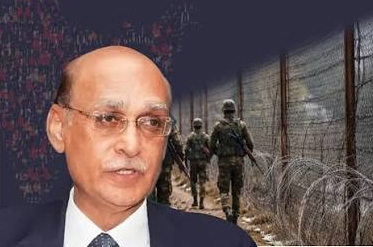 Sanjay Pandita Sanjay Pandita
Early Times Report
Jammu, Aug 8: Reaching Jammu and Kashmir on August 10 for a three-day study, the high-level committee headed by retired Justice Prakash Prabhakar Navlekar will undertake a detailed assessment of demographic changes in Jammu and Kashmir, including cross-border movement, infiltration, identification of foreign nationals, verification of documents and unusual patterns of settlement.
The committee will visit Jammu and Kashmir from August 10 to 12 and conduct a ground-level assessment of areas considered sensitive from the perspective of cross-border movement and demographic changes.
It is expected to interact with local residents and gather information from security and intelligence agencies.
The committee was constituted to examine what has been described as unusual changes in the demographic profile of Jammu and Kashmir, including concerns related to the alleged infiltration and settlement of Rohingya and Bangladeshi nationals.
The committee will examine the entire chain—from cross-border movement and alleged infiltration to settlement patterns, identification of foreign nationals, authenticity of documents and subsequent movement within the Union Territory.
It will also study the reasons and routes behind cross-border movement and suggest measures to strengthen border management. Its findings will be submitted to Union Home Minister Amit Shah.
During its three-day visit, the committee is expected to cover sensitive areas and interact with officials and residents to understand the ground situation.
The committee is likely to focus on areas along the International Border (IB) and the Line of Control (LoC). Districts such as Kathua and Samba along the IB, and Rajouri, Poonch, Kupwara and Baramulla along the LoC, could come under its assessment.
The exercise is expected to examine not only the movement of people across the border but also the mechanisms through which individuals allegedly establish identities, obtain documents and subsequently move to other parts of Jammu and Kashmir.
The committee is expected to seek answers to several questions, including:
· How many people allegedly entered Jammu and Kashmir from across the border?
· Where did they settle after entering the region?
· How were they identified at the local level?
· Where and how were identity and other documents issued or obtained?
· How did such individuals subsequently move from one area to another?
The committee is also expected to examine the challenge of alleged movement from border areas into the interior districts and subsequently towards the Kashmir Valley.
Security concerns surrounding such movement have gained attention following recent cases involving the identification and verification of foreign nationals in districts including Reasi, Ramban and Kathua.
The committee may therefore examine what has been described as a potential “migration corridor” extending from border areas to Jammu and further towards the Kashmir Valley, besides studying the administrative and security mechanisms used to track and verify such movement.
As part of its assessment, the committee may examine rented accommodation, labour settlements, construction sites, small businesses and other areas where the presence of foreign nationals has been reported.
The panel could also seek official data on the number of foreign nationals identified in recent years, the number subjected to verification, cases in which nationality was established and instances where deportation or other legal action was initiated.
Experts believe the committee's mandate goes beyond merely examining cases of alleged infiltration. It is expected to study the broader network involved in movement, identification, documentation, settlement and subsequent relocation.
According to sources, security agencies are likely to provide the committee with information relating to alleged infiltration routes, identification processes, documentation, settlement patterns and the subsequent movement of individuals within Jammu and Kashmir.
The exercise is aimed at building a comprehensive picture of demographic changes and identifying gaps in border management, documentation and verification mechanisms. |
|
|
|
|
|
|
|
|
|
|
|
|
| |
| |
|
|
|
|
 |
|
|
