news details |
|
|
| University of Jammu organises panel discussion on "BRICS 2026: The Delhi Declaration" | | | 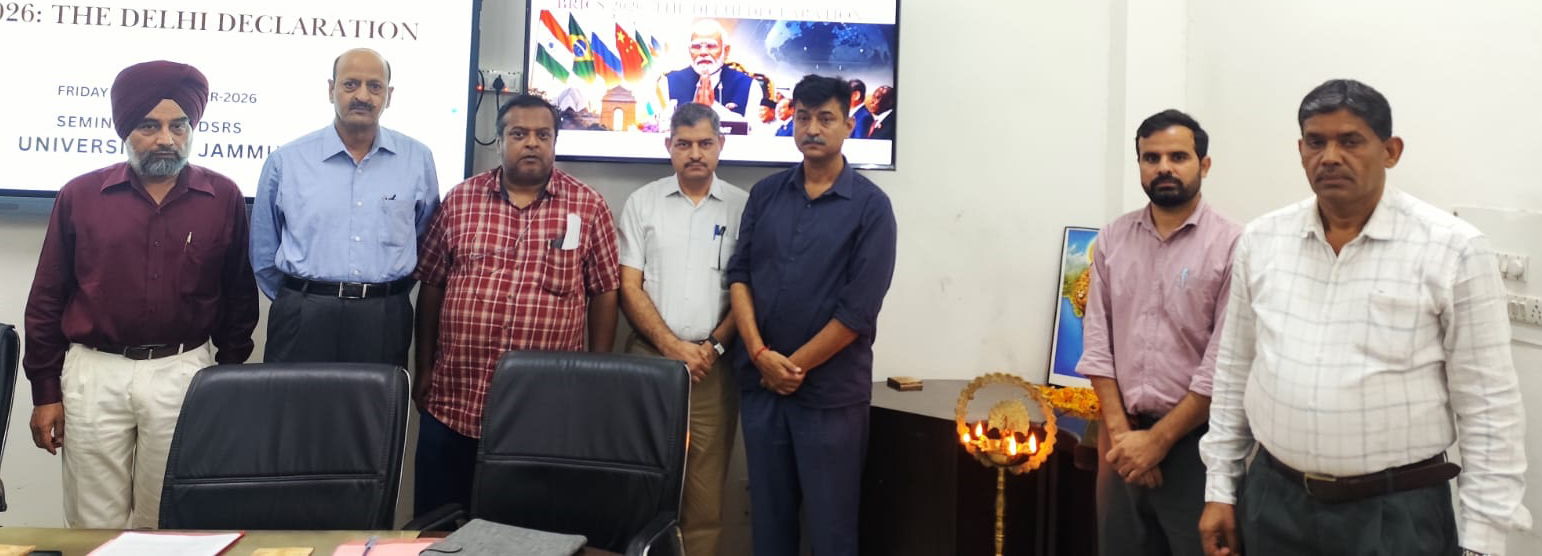 Early Times Report Early Times Report
JAMMU, Sept 19: The Department of Strategic and Regional Studies (DSRS), University of Jammu, organised a panel discussion on "BRICS 2026: The Delhi Declaration" at the Seminar Hall of the Department, bringing together eminent academicians and a senior civil servant to deliberate on the evolving significance of BRICS and its implications for India and the changing world order.
The discussion was moderated by Prof. Dipankar Sengupta, Department of Economics, University of Jammu. The panellists included Prof. Baljit Singh Mann, Head, Department of Political Science, University of Jammu; Prof. Falendra K. Sudan, Department of Economics, University of Jammu; and Sh. Nagendra Singh Jamwal, JKAS, J&K UT Government.
Prof. Baljit Singh Mann focused on the geopolitical and political dimensions of BRICS. He noted that the expansion and institutional evolution of the grouping reflect wider changes in international power relations. He emphasised the importance of examining BRICS in the context of India's foreign-policy priorities and its engagement with major global powers. He also pointed out that the Delhi Declaration provides an important framework for understanding the emerging priorities of BRICS and its possible contribution to a more representative international system.
Speaking from an economic and developmental perspective, Prof. Falendra K. Sudan underlined the importance of economic cooperation, trade, investment, financial institutions and development partnerships within BRICS. He discussed the opportunities and challenges associated with greater economic integration among member countries and stressed the need to examine BRICS in terms of its implications for developing economies and the Global South. He also drew attention to the importance of institutional mechanisms for translating declarations into meaningful economic cooperation.
Sh. Nagendra Singh Jamwal, JKAS, brought an administrative and contemporary policy perspective to the discussion. He highlighted the relevance of global economic and geopolitical developments for India, particularly in the context of connectivity, investment, development and India's integration with emerging global economic networks. He emphasised the importance of understanding international developments from the perspective of their implications for governance and regional development.
In his presidential remarks, Prof. Dipankar Sengupta observed that the growing importance of BRICS needs to be understood against the backdrop of transformations taking place in the global economic and political order. He emphasised that the grouping represents an important platform for dialogue among emerging economies and that its evolution should be examined beyond the conventional framework of economic cooperation. He also highlighted the significance of India's role in shaping discussions concerning global governance, development and the interests of the Global South.
Earlier, in his welcome address, Prof. Virender Koundal, Director, DSRS, highlighted the growing significance of BRICS in the evolving global order and emphasised the relevance of the Delhi Declaration for India and the Global South. He expressed hope that the deliberations would provide meaningful insights into the economic, geopolitical and strategic dimensions of BRICS.
During the question-answer session, the panellists addressed issues relating to the changing architecture of global governance, India's position within BRICS, economic cooperation, the Global South, emerging geopolitical alignments and the broader implications of the Delhi Declaration. The interdisciplinary nature of the panel enabled participants to examine BRICS from political, economic, strategic and administrative perspectives. |
|
|
|
|
|
|
|
|
|
|
|
|
| |
| |
|
|
|
|
 |
|
|
