news details |
|
|
| India won’t bow to threats, will defend its strategic autonomy: Rajnath | | | 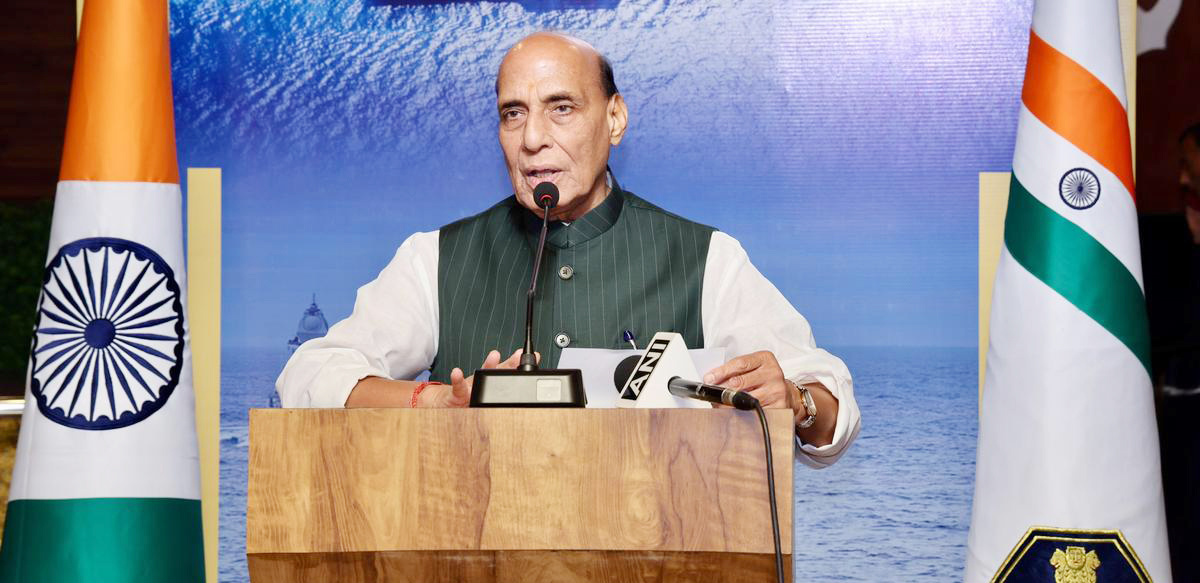 Early Times Report Early Times Report
Jammu, Sept 27: Defence Minister Rajnath Singh on Sunday asserted that while India remains committed to peace and global stability, it will take all necessary measures to safeguard its security and strategic autonomy whenever threatened.
Addressing a Defence Conclave in New Delhi, Singh said India does not seek to occupy the territory of any nation and believes in peaceful coexistence, but cautioned against mistaking its commitment to peace for weakness.
“India seeks global stability, but not at the cost of its strategic autonomy. We are firmly committed to protecting our security and strategic interests whenever they are challenged,” he said.
Taking a strong stand against terrorism, the Defence Minister said there could be no meaningful dialogue with countries that promote terrorism against India. He stressed that nations using terrorism as an instrument of state policy or providing shelter to terrorists must be reminded that terrorism cannot serve as a strategic asset. Referring to Prime Minister Narendra Modi’s recent remarks at the SCO Summit, Singh said India remains fully entitled to take all necessary measures against terrorism as long as a neighbouring country continues to support such activities.
Emphasising national unity as a cornerstone of national security, Singh said safeguarding the nation is not the sole responsibility of the armed forces but a collective duty of every citizen. He urged people to rise above divisions based on religion, caste, language, region and other identities and place national interest above narrow considerations.
Describing India as a civilisational power, the Defence Minister said the country’s rise is rooted in inclusive development rather than confrontation. He said India’s approach is guided by its democratic and civilisational traditions, the ideals of “Vasudhaiva Kutumbakam” and “Sabka Saath, Sabka Vikas”, and the strategic pillars of respect, dialogue, prosperity, security and culture.
Highlighting India’s growing engagement with the Global South, Singh said the country has emerged as a trusted partner and “Vishwa Bandhu”. He noted that under the Vaccine Maitri initiative, India supplied more than 30 crore COVID-19 vaccine doses to over 100 countries and has extended support to developing nations through medicines, digital payment solutions and capacity-building initiatives.
On defence self-reliance, Singh said India is rapidly developing indigenous capabilities ranging from aircraft and drone engines to next-generation fighter aircraft. He highlighted the remarkable growth in defence exports, which increased from Rs 686 crore in 2013-14 to a record Rs 38,424 crore in 2025-26, with Indian defence products now reaching over 100 countries.
“Made in India is increasingly becoming a symbol of trust in the global defence market,” he said, adding that growing international demand for Indian missiles, radars, ammunition and defence platforms reflects confidence in the country’s technological and manufacturing capabilities.
The Defence Minister said the defence budget has increased to Rs 7.85 lakh crore in 2026-27 from about Rs 2.53 lakh crore in 2013-14. Of the capital acquisition budget, around Rs 1.39 lakh crore, or 75 per cent, has been earmarked for procurement from domestic industry to strengthen indigenous manufacturing and MSME participation.
Referring to evolving security challenges, Singh said warfare is no longer confined to conventional battlefields and increasingly encompasses cyber, space, electronic and information warfare, alongside emerging technologies such as artificial intelligence, drones, autonomous systems, quantum technology and hypersonic platforms. He stressed the need for India to develop future-ready capabilities across these domains.
The Defence Minister also highlighted government efforts to reduce strategic vulnerabilities in critical sectors such as technology, energy, data and supply chains through initiatives in semiconductors, critical minerals and energy security.
Stressing the importance of indigenisation, Singh said 509 defence equipment and weapon systems have been placed on positive indigenisation lists issued by the armed forces, while Defence Public Sector Undertakings have identified over 5,400 items for domestic production. He added that nearly 3,300 of these items have already been indigenised.
He noted that India’s defence ecosystem now comprises DPSUs, private industry, more than 16,000 MSMEs, startups, universities and research institutions. Investment proposals worth around Rs 70,000 crore have been received in the Uttar Pradesh and Tamil Nadu Defence Industrial Corridors, with about Rs 10,000 crore already invested.
Highlighting innovation-driven initiatives such as iDEX and ADITI, Singh said 676 startups and innovators had been engaged through iDEX by March 2026, with 551 contracts signed. The Ministry has approved procurement worth over Rs 2,400 crore from startups and MSMEs and sanctioned development projects exceeding Rs 1,500 crore.
In a significant announcement, Singh said DRDO-developed technologies for conventional missile systems would be transferred to eligible Indian industries, enabling qualified private companies to undertake production. He said the move would strengthen the preparedness of the armed forces and ensure timely delivery of missile systems.
Concluding his address, the Defence Minister reiterated that India’s long-term objective is to achieve self-reliance across the entire defence spectrum, from components and subsystems to complete weapon platforms. He said strengthening indigenous capabilities is essential for enhancing strategic autonomy, defence preparedness and a resilient national defence industrial ecosystem. |
|
|
|
|
|
|
|
|
|
|
|
|
| |
| |
|
|
|
|
 |
|
|
