| ‘Peace is not weakness’: Rajnath warns Pak of stronger response | | Flags rise of ‘white-collar terror’, hails Captain Smit Machhar’s courage to foil terror attack | | 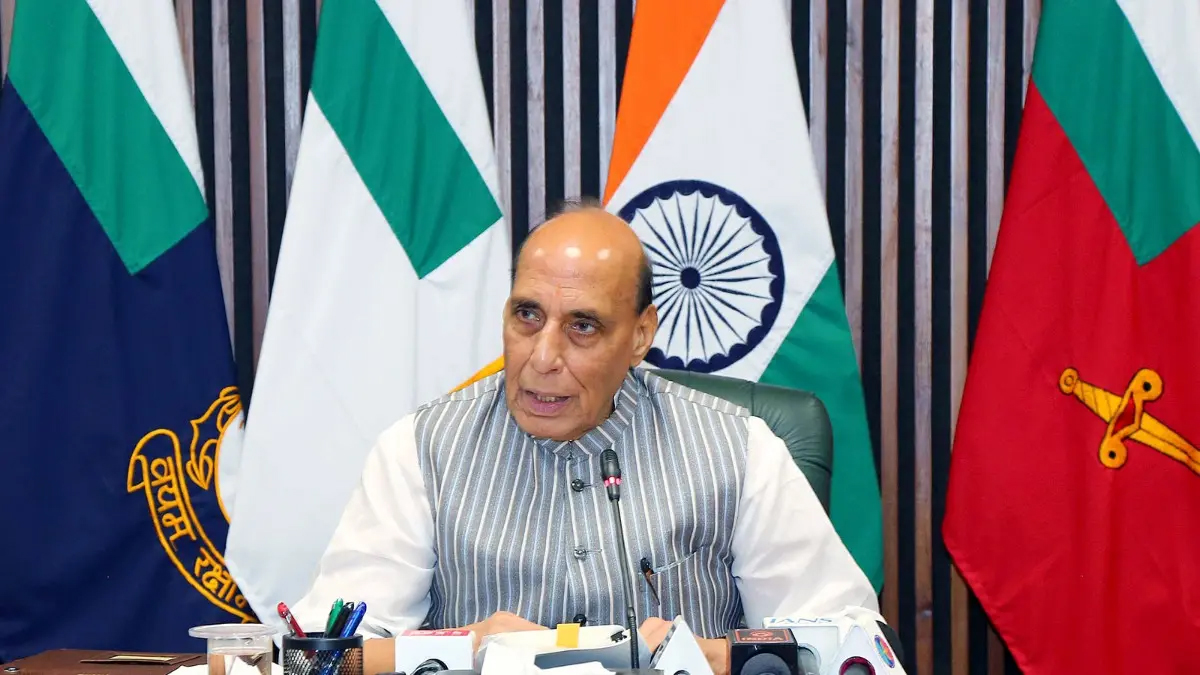 Early Times Report Early Times Report
Jammu, Oct 15: Delivering a blunt message to Islamabad, Defence Minister Rajnath Singh said on Thursday that any fresh act of terror originating from Pakistan would be met with an even stronger response from India.
Speaking at a Defence Conclave in the national capital, Singh described Operation Sindoor, the Balakot airstrikes and the surgical strikes as more than military operations.
In his words, these operations marked a decisive shift from diplomatic condemnation to proactive action aimed at striking terrorism at its source. India’s culture favours dialogue and coexistence, he said, but its love of peace should never be mistaken for weakness.
He added that since 2014 the “shelf life” of most terrorists has dropped to under a year, as security forces neutralise them soon after they take up arms.
Describing a “5D” challenge of disinformation, destabilisation, disruption, deception and destruction, he said terrorism now goes beyond organised groups to include lone-wolf attacks and “white-collar terrorism”, which make it harder for agencies to spot radicalised individuals in time.
Citing the recent case of a co-pilot who allegedly tried to crash a passenger aircraft, and Captain Smit Machhar, who risked his life to prevent a major attack, he said one alert, courageous citizen can foil an entire plot. Fighting terror, he stressed, needs aware and responsible citizens as much as capable security agencies.
Calling for a shift from hard and soft power to “smart power”, Singh said modern defence must pair precision-guided weapons and loitering mu Operation Sindoor, the Balakot airstrikes and the surgical strikes marked a decisive shift from diplomatic condemnation to proactive action aimed at striking terrorism at its source
India’s culture favours dialogue and coexistence but its love of peace should never be mistaken for weakness.
Since 2014 the “shelf life” of most terrorists has dropped to under a year, as security forces neutralise them soon after they take up arms.
Captain Smit Machhar risked his life to prevent a major attack, he proved that one alert, courageous citizen can foil an entire plot.
He credited reforms under Prime Minister Narendra Modi for India’s growing confidence, saying Operation Sindoor showcased indigenous systems such as the Akash missile system and BrahMos.
He said that the defence production has climbed to a record Rs 1.78 lakh crore from Rs 40,000 crore in 2014, with a target of Rs 2 lakh crore this year and Rs 3 lakh crore by 2029.
“Defence exports have hit an all-time high of Rs 39,000 crore, up from Rs 686 crore in 2013-14, reaching nearly 100 countries. The target is Rs 50,000 crore by 2029”, he said, adding, “Seventy-five per cent of the modernisation budget is earmarked for Indian industry, and more than 500 companies now operate in the sector”.
“Five positive indigenisation lists covering 509 items have been issued, with a sixth coming soon. Defence PSUs have indigenised 3,255 of 5,012 identified items”, the Defence Minister said, adding, “Of 175 ammunition variants used by the forces, 159 are now made in India. Through iDEX, 676 start-ups and innovators have been engaged and 551 contracts signed. The defence start-up ecosystem has grown from a few dozen in 2018 to over 2,000”.
He also noted that OFB’s corporatisation has turned loss-making units into profitable enterprises, and that India is the fourth country to set a national standard for bulletproof jackets.
Concluding, Singh said he was confident that India would emerge as a “Viksit Bharat” by its centenary of independence and lead the world in technology, economy and defence. |
|