 Early Times Report Early Times Report
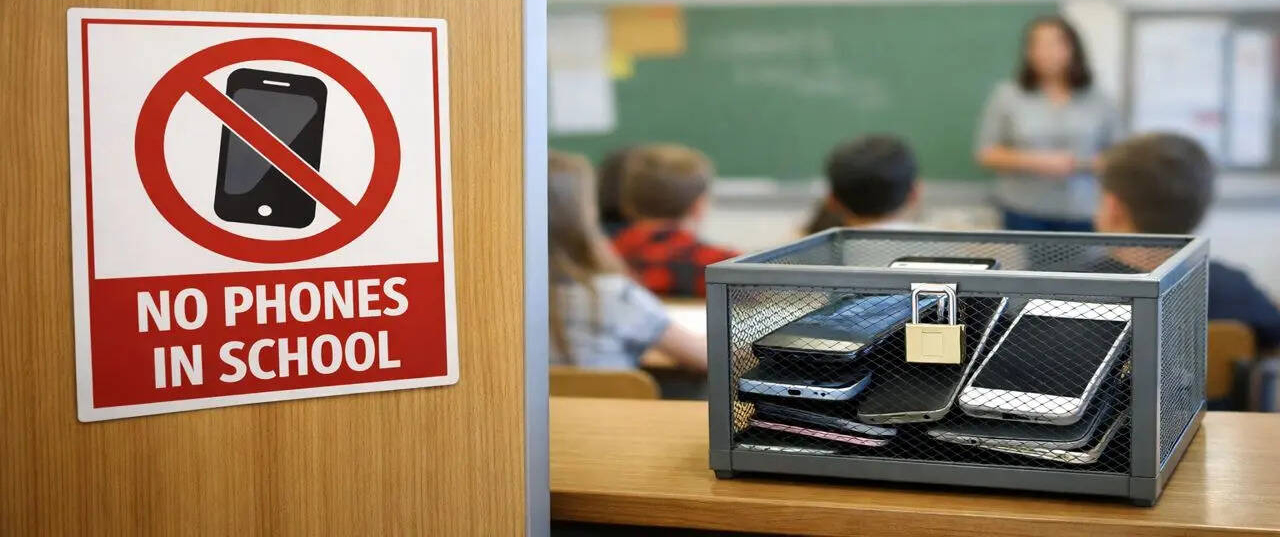
New Delhi, Mar 22: More than half of the countries have banned phones in schools amid mounting concerns about declining attention in classrooms and cyberbullying, according to the UNSECO’s Global Education Monitoring (GEM) team.
The team found that girls are twice as likely as boys to suffer from eating disorders exacerbated by social media usage.
Facebook’s own research revealed that 32 per cent of teenage girls felt worse about their bodies after using Instagram.
The report noted alarming trends related to TikTok’s algorithm, which targets teenagers with body image content every 39 seconds and promotes content related to eating disorders every eight minutes.
“Recent global monitoring shows that 114 education systems now have a national ban on mobile phones in schools, representing 58 per cent of countries worldwide. The expansion has been rapid. Less than 1 in 4 countries (24 per cent) had bans in June 2023, when it was first monitored in the 2023 GEM Report. By early 2025, this had risen to 40 per cent, and by March 2026, that share is almost 20 percentage points higher,” a senior member of GEM said.
“The growth reflects mounting concerns about declining attention in classrooms, cyberbullying, and the broader influence of digital environments on children. But the global picture is more nuanced than a simple shift toward prohibition,” the official added.
Several countries have introduced national bans since late 2025, continuing the upward trend. Recent additions include Bolivia, Costa Rica, Croatia, Georgia, the Maldives and Malta.
France is one of the countries where the debate continues to evolve. It introduced one of the most widely cited early bans on mobile phones in schools, prohibiting their use in primary and lower secondary education.
According to the GEM report, policymakers are now examining whether further regulation is needed.
A legislative proposal currently under consideration in the French parliament aims to establish more specific rules governing smartphone use in schools.
In many cases, bans apply during the school day or inside classrooms, with some systems allowing phones only for educational purposes, specific groups of pupils (such as those with disabilities or illness), or requiring them to be switched off and stored away. At the same time, not all governments are opting for outright bans. Some countries have recently adopted national regulations requiring schools to develop policies restricting phone use, without imposing a strict nationwide prohibition,” the report said.
Comoros, Colombia, Estonia, Lithuania, Iceland, Peru, Indonesia, Serbia, Poland and the Philippines are among such countries, the report noted. The approach reflects a shift toward delegating responsibility to schools and school leaders while still acknowledging the need to control phone use, it said.
Debates at a sub-national level take place elsewhere as governments try to balance national direction with school-level autonomy.
In countries where education systems are decentralised, restrictions are often introduced first at regional or local levels.
In the United States, where no nationwide ban exists, 39 states have introduced bans or regulations requiring school districts to adopt policies restricting phone use in classrooms.
“Most of the other states have filed bills to regulate phone use as well. These cases show how policy change often starts locally before spreading nationally,” the report said. It asserted that emotional well-being is crucial for academic success, and the impact of social media on it is particularly pronounced among girls.
Increased interaction with social media at age 10 has been linked to worsening socioemotional difficulties as they grow older, a trend not observed among boys, it said.
“As a result, some countries have implemented or are considering restrictions on social media use for children, including legislation in Australia, France, Portugal and Spain, as well as discussions in Denmark, the Czech Republic, and Indonesia,” the report said. |