news details |
|
|
| Country has adequate fuel stocks, no need to panic: Rajnath Singh | | | 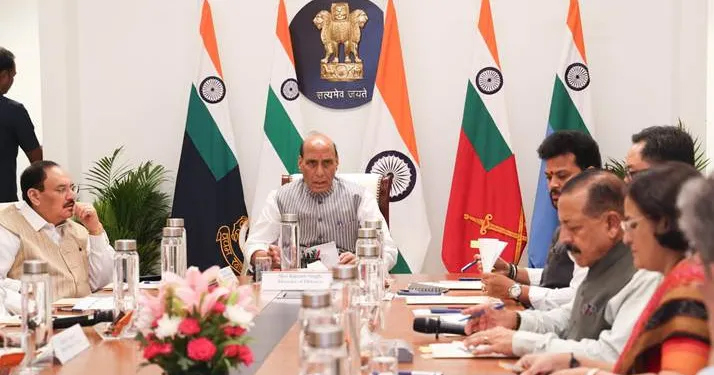 Early Times Report Early Times Report
Jammu, May 11: Defence Minister Rajnath Singh on Monday assured the nation that there is no shortage of petroleum products and urged citizens to remain calm, stating that India has sufficient reserves of crude oil, natural gas, and LPG to withstand any temporary disruptions arising from the escalating conflict in West Asia. Chairing the fifth meeting of the Informal Group of Ministers (IGoM) on West Asia at Kartavya Bhawan-2 in New Delhi, Rajnath Singh reviewed the latest developments in the region and assessed India’s preparedness to minimise the impact of the crisis on the country’s economy and citizens.
The high-level meeting was attended by Union Ministers Jagat Prakash Nadda, Hardeep Singh Puri, Ashwini Vaishnaw, Kiren Rijiju, Kinjarapu Rammohan Naidu, Sarbananda Sonowal, and Jitendra Singh.
Officials informed the ministers that India currently holds reserves equivalent to 60 days of crude oil, 60 days of natural gas and 45 days of LPG rolling stock, ensuring that domestic demand can be fully met even if global supply chains are disrupted.
The government also noted that India’s foreign exchange reserves stand at a robust 703 billion US dollars, providing a strong buffer against global volatility.
India is the world’s third-largest oil refiner and fourth-largest exporter of petroleum products, supplying fuel to more than 150 countries while fully meeting domestic requirements.
Rajnath Singh emphasized that there is absolutely no reason for panic buying of fuel or essential commodities.
In a post on X after the meeting, the Defence Minister said the government is taking all concrete steps necessary to prevent shortages and maintain uninterrupted supply chains.
“The people must remain calm and avoid any kind of panic,” he said, adding that the country has adequate stocks of both petroleum products and essential commodities.
Officials also informed the IGoM that the current call for conservation is not due to scarcity but is intended to strengthen India’s long-term resilience should the international crisis persist.
Despite global crude oil prices remaining at exceptionally high levels for more than 70 days since the conflict began, petroleum prices in India have remained stable.
In contrast, many countries have witnessed fuel price increases ranging from 30 to 70 percent.
According to the government, India’s oil marketing companies are absorbing losses of nearly ₹1,000 crore per day, with under-recoveries estimated at almost Rs 2 lakh crore during the first quarter of 2026, to shield consumers from steep price hikes.
The meeting reviewed Prime Minister Narendra Modi’s appeal to citizens to adopt more prudent consumption habits in order to reduce the burden on the economy.
The Prime Minister has urged people to use public transport, metros and carpooling to reduce petrol and diesel consumption, avoid unnecessary foreign travel, choose domestic tourism, celebrate within India and postpone non-essential gold purchases for one year.
Farmers have also been encouraged to cut chemical fertilizer use by half, adopt natural farming methods and use solar-powered irrigation pumps instead of diesel-operated systems.
Rajnath Singh directed all ministries and state governments to institutionalize fuel efficiency measures, public awareness campaigns and responsible consumption behaviour.
The Defence Minister said the government’s immediate priority is to ensure uninterrupted energy flows, preserve economic stability and secure maritime trade routes.
He stressed the need to accelerate India’s transition to renewable energy, diversify sources of energy imports and increase investments in energy-efficient technologies.
Rajnath Singh also called for a re-evaluation of India’s strategic reserves to better prepare for future supply chain disruptions.
The ministers were briefed on steps taken to support industry, particularly micro, small and medium enterprises (MSMEs).
The Union Cabinet on May 5 approved the Emergency Credit Line Guarantee Scheme (ECLGS) 5.0, which aims to provide an additional credit flow of Rs 2.55 lakh crore. The scheme offers 100 percent credit guarantee coverage for MSMEs and 90 percent coverage for non-MSMEs and the airline sector.
The Finance Ministry has also introduced force majeure-related relief measures in public procurement contracts, allowing performance deadlines to be extended by two to four months from February 28, 2026, in view of the ongoing crisis.
Rajnath Singh said the West Asia conflict should not be viewed as an isolated event, noting that international crises affect all countries in today’s interconnected world.
He underscored the importance of strategic crisis anticipation, early warning assessments, scenario planning and timely whole-of-government preparedness.
The Defence Minister reiterated that while the global situation remains challenging, India is well prepared to safeguard its energy security, protect its economy and ensure uninterrupted supplies of essential commodities. |
|
|
|
|
|
|
|
|
|
|
|
|
| |
| |
|
|
|
|
 |
|
|